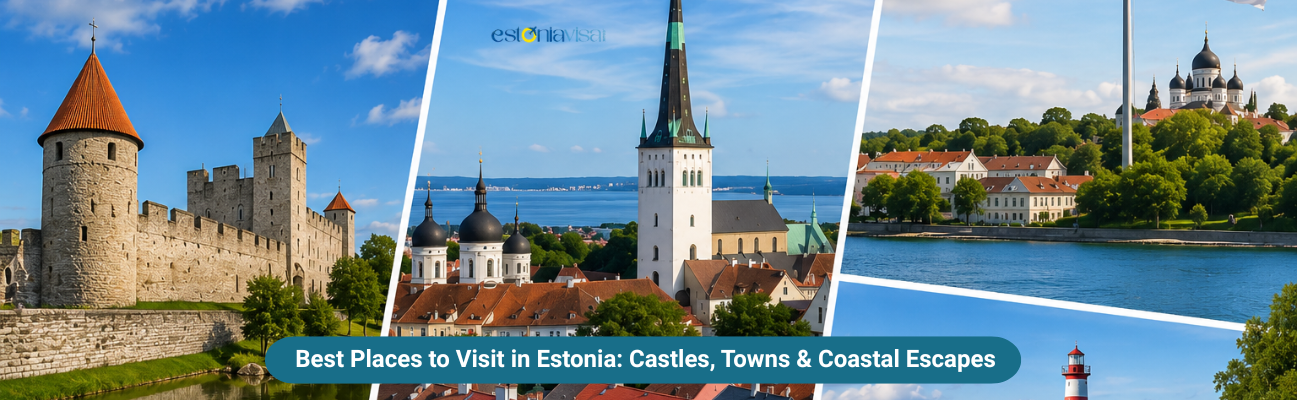
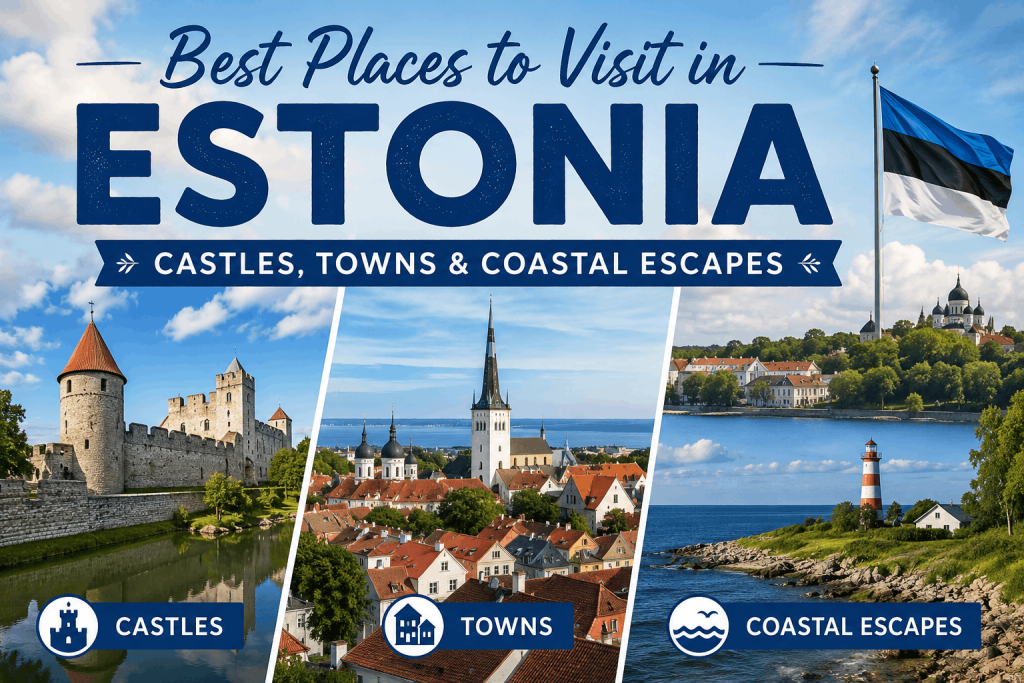
The best places to visit in Estonia span medieval castles, ancient national parks, and remote Baltic islands in a country rarely given the attention it deserves. Tallinn’s UNESCO-listed old town is the natural centrepiece, but the real depth of this Baltic nation lies well beyond the capital.
Narva Castle’s fortified river frontier, Saaremaa Island’s 14th-century stronghold, Lahemaa National Park’s sprawling coastal wilderness, and Pärnu’s 19th-century resort promenade each tell a different part of the same story. Estonia is compact, affordable, and consistently underrated!
This guide covers all eleven destinations, with everything needed to plan, book, and enjoy the trip in full with an Estonia tourist visa from UK.
| Destination | Type | Best Known For | Standout Feature | Travel from Tallinn |
| Tallinn Old Town | Medieval City | UNESCO-listed walled city | Toompea Hill & Raekoja plats | Base City |
| Lahemaa National Park | National Park | Estonia’s oldest national park | Viru raba bog boardwalk | 70 km |
| Tartu | University City | Intellectual capital & student culture | Estonian National Museum | 185 km |
| Saaremaa Island | Island | 14th-century castle & mud-spa culture | Kuressaare Episcopal Castle | 200 km + ferry |
| Pärnu | Coastal Resort | Baltic Sea beaches & timber villas | Beach Promenade & Ammende Villa | 130 km |
| Soomaa National Park | National Park | “Fifth season” spring flooding | Hüpassaare trail & bog-shoeing | 150 km |
| Hiiumaa Island | Remote Island | Maritime history & historic lighthouses | Kõpu Lighthouse (active since 1531) | 150 km + ferry |
| Narva Castle | Border Fortress | Medieval stronghold on the Russian frontier | Tall Hermann Tower panoramic view | 210 km |
| Haapsalu | Coastal Town | 19th-century romantic Baltic resort | Episcopal Castle & Promenade concerts | 100 km |
| Viljandi | Hill Town | Teutonic castle ruins & creative culture | Traditional Folk Music Festival (July) | 160 km |
| Rakvere | Castle Town | Interactive, hands-on medieval fortress | Rakvere Castle live history experience | 100 km |
Estonia is celebrated for its pristinely preserved medieval capital along with the vast and untamed national park systems. Apart from this, the fascinating country is famous for a collection of Baltic islands that retain an authentic, slow-paced character largely absent from more commercially developed coastal destinations across Northern Europe.
Here is what truly defines Estonia as a premier travel destination:
For the first-time visitors researching things to do in Estonia, the country stands out for its UNESCO-protected medieval heritage, pristine forests, Baltic islands, and some of the most accessible wilderness experiences in Northern Europe.
Must Read: Best Things to do in Estonia
Interesting fact: The medieval Old Town of Tallinn was inscribed on the UNESCO’s World Heritage List in 1997 and covers approximately 113 hectares, according to the UNESCO World Heritage Convention database.
The best destinations in Estonia extend well beyond Tallinn. This Estonia travel guide maps out the country’s top medieval fortresses, ancient bogs, Baltic islands, and coastal resorts in the exact geographic sequence most travellers encounter them.
The fairytale medieval core of Tallinn is divided into two distinct levels:
Insider Tip: Avoid the heavily commercialised crowds on Viru Street. Instead, duck through the stone archway into Katariina käik (St. Catherine’s Passage) to watch local artisans blow glass in a quiet, echoing medieval alley.
Also Read: Is Tallinn Worth Visiting? Travel Tips & Guide
Located just 70 km east of the Tallinn, the Lahemaa National Park is a vast wonderland of mossy pine forests, dramatic coastal cliffs along with the sweeping boglands. It stands proudly as Estonia’s largest protected wilderness. Here, pristine nature meets history, allowing you to wander through grand Baltic-German estates like Sagadi and Palmse Manor, where the manicured gardens and serene ponds are entirely free to explore.
Among all national parks in Estonia, Lahemaa is the most visited and offers an ideal introduction to the country’s forests, bogs, coastline, and manor-house heritage.
Insider Tip: Time your visit for early morning. Watching the sunrise burn the mist off the mirrored bog pools is arguably the most magical, crowd-free experience in the country.
Tartu is Estonia’s vibrant intellectual heart and second city, pulsing with student life since the university’s founding in 1632. It is a city that fully rewards an overnight stay. Wake up early to catch a peaceful, misty morning stroll along the scenic Emajõgi riverfront before the cafes burst into life.
Often overlooked by the international visitors, Tartu Estonia offers a completely different experience from the Tallinn. This is because, Tartu combines the academic heritage, contemporary culture as well as a youthful atmosphere!
Insider Tip: When exploring the Town Hall Square, look closely at the historic buildings. Because of the marshy ground beneath, parts of the square visibly lean and slope—giving it a quirky, un-engineered charm.
Saaremaa is the largest island of Estonia and is popular for offering a tranquil escape. That is due to the wild juniper forests, coastal limestone cliffs, and a slower pace of life. To get here, take a scenic 25-minute car ferry from the Virtsu to Kuivastu via the Praamid ferry service.
Among the many Estonian Islands, Saaremaa Island is the most popular thanks to its medieval castle, spa culture, windmills along with the peaceful Baltic landscapes.
Insider Tip: Summer ferry queues can stretch for hours. Book your vehicle tickets online well in advance to skip the main standby lines and guarantee your crossing time.
Make sure to get your Estonia Tourist Visa from UK for a hassle-free trip to Saaremaa and beyond.
Pärnu is Estonia’s official summer resort capital, where broad Baltic shores meet quiet, tree-lined streets filled with historic wooden villas. It is an absolute paradise from June through August when the town bursts into life, though it quickly shifts into a sleepy, silent coastal town once September arrives.
Insider Tip: While the Gulf of Riga beaches are stunning, water temperatures rarely climb past 18–20°C. If the sea feels too brisk, skip the swim and stroll the vibrant beach promenade with a local ice cream instead.
Known as the premier beach destination of the country, Pärnu Estonia attracts visitors who prefer the sandy beaches, spa experiences along with the relaxed Baltic Sea atmosphere.
All you need to do is book an Estonia Schengen Visa Appointment from UK to get started!
Also Read: Pärnu Estonia Travel Guide 2026
Soomaa is the untamed wilderness of peat bogs and floodplains of Estonia. It is globally famous for its unpredictable “fifth season”—a spectacular spring period when melting snow swells the rivers, completely submerging the surrounding forests.
Together with Lahemaa, Soomaa National Park showcases why the national parks in Estonia are among the country’s greatest travel assets.
Insider Tip: If you visit during the fifth season, you can literally paddle a canoe right between giant mossy tree trunks and over flooded country roads. It is a surreal, unforgettable experience.
Hiiumaa is Estonia’s second-largest island, offering a blissfully quiet, forested alternative to the busier Saaremaa. Life here is dictated entirely by the sea and the wind. To experience its true magic, hop on the 75-minute ferry from Rohuküla.
For travellers seeking authentic experiences away from crowds, Hiiumaa Island is one of the finest Estonia hidden gems.
Insider Tip: Public transport here is incredibly scarce outside of summer. Skip the bus entirely and rent a bicycle or car to explore the empty, sweeping coastal roads at your own rhythm.
In case you didn’t know: Kõpu Lighthouse on Hiiumaa Island has been operational since 1531, making it one of the oldest continuously active lighthouses in the world, according to Estonian Transport Administration.
Narva Castle (Hermanni linnus) sits directly on the front line of geopolitics. Standing on the western bank of the Narva River, this formidable 13th-century fortress faces Russia’s Ivangorod fortress across a mere 150 metres of water—making it one of the most visually tense and unique historical sites in Europe.
Few Estonia tourist attractions offer such a striking historical setting as Narva Castle, which stands directly opposite Russia across the Narva River.
Insider Tip: The surrounding city was flattened in WWII and rebuilt in blocky, Soviet-style architecture. The sudden transition from stark concrete blocks to a towering medieval stronghold creates an incredible visual contrast for photographers.
Just ensure that you understand all the document requirements for Estonia visa from London correctly for a smooth visa acquisition experience!
Haapsalu is a romantic, slow-paced seaside sanctuary located just 100 km west of the Tallinn. Famous for its ornate 19th-century wooden villas as well as the healing sea mud, this place works wonderfully as a peaceful day trip or a relaxing one-night stop away from the heavier crowds.
While the Tallinn and Pärnu attract the largest visitor numbers, Haapsalu remains one of the most underrated Estonia hidden gems. In fact, the place is known amongst the locals for its seaside atmosphere, historic spa culture as well as the beautifully preserved wooden architecture.
Insider Tip: If you visit during the full moon in August, you can catch the legendary “White Lady” festival, where a famous medieval ghost is said to appear in the cathedral’s window.
Viljandi is a soulful, hillside town tucked away in south-central Estonia, built directly around the dramatic ruins of a 13th-century Teutonic Order castle. It serves proudly as the country’s capital of folk music and creative crafts.
Although often overlooked in mainstream Estonia travel guides, Viljandi rewards visitors with medieval ruins, lakeside scenery, and one of the country’s strongest traditions of folk music and cultural heritage.
Insider Tip: To reach the castle ruins, walk across the iconic, 50-metre-long swinging rope suspension bridge that hangs 15 metres above a lush green ravine. The sweeping sunset views over Lake Viljandi from the top are absolutely magical.
The ideal time to go to the Estonia depends entirely on your travel style: summer offers the endless daylight for outdoor adventures, while the winter season transforms the capital into a snowy, medieval fairytale.
Summer is the ultimate window for coastal getaways and wilderness exploration. Midsummer rewards you with the magical “White Nights” wherein you get to experience up to 18 hours of continuous daylight.
Shoulder seasons are a goldmine for budget-conscious travellers who value peace and quiet over hot beach weather.
Winter travel is best kept focused purely on the capital. The legendary Tallinn Christmas Market on Raekoja plats runs from 20 November 2026 to 6 January 2027.
Ensure that you understand the documents required for Estonia Visa from London and apply in advance to avoid delays during peak travel periods.
Worth knowing: Estonia’s Jaanipäev (Midsummer) national holiday falls on 23–24 June each year and is the country’s most widely observed annual celebration, according to the official national tourism portal of Estonia.
Must Read: Best Things to do in Estonia for Nature, Islands & Culture
“James Obuye from Manchester had spent three weeks refreshing the visa appointment portal daily, with no success. His Baltic itinerary was fully planned, flights were booked, and the Estonia stop was the centrepiece of the trip. After contacting Estonia Visa, our team secured a fast-track appointment within 48 hours.”
“I’d given up on getting the Estonia visa in time. These slots disappear within minutes of going live. The team at Estonia visa got me an appointment I couldn’t have found on my own. My Estonia trip happened because of it.”
This seamless 7-day loop covers Estonia’s ultimate highlights at a realistic, rewarding pace. While a 5-day trip works well for a fast capital-and-island teaser, a full week lets you unlock the country’s best historic towns and wild spaces without spending your entire holiday behind the wheel.
So, when will you apply for Estonia Visa from UK? Estonia awaits!
In case you didn’t know: Tallinn was home to approximately 458,518 residents in 2025, meaning nearly one-third of Estonia’s population lives in the capital region.
The best places to visit in Estonia cover more ground, culturally and geographically, than the country’s modest international outlook suggests.
But, are you still waiting to secure an Estonia visa appointment from UK slot? Concerned that waiting any longer will lead to trip cancellations?
Instead of doing that, apply through a professional partner like ESTONIA VISA. We are a reliable visa agency in the UK helping holidaymakers like you get lightning-fast appointments. This allows you to complete the visa process quickly and obtain the visa!
From Tallinn’s medieval walls and Tartu’s university quarter to the windswept shores of Saaremaa and the boreal forests of Lahemaa, Estonia delivers a depth of experience that is genuinely hard to match at this price point in Europe. It rewards travellers who arrive with time and curiosity in equal measure.
So, grab the Estonia visa and secure your chance of experiencing this gem of a nation!
The Tallinn Old Town, Lahemaa National Park, Tartu as well as the Saaremaa Island offer the broadest introduction to the country. They cover medieval history, ancient natural landscapes, university culture along with the Baltic island life. All four are reachable without a hire car, though one helps significantly for Lahemaa.
Saaremaa Island suits most first-time visitors: a medieval castle, a meteorite crater, traditional windmills, spa culture, and a frequent ferry connection from Virtsu. Hiiumaa Island is the better choice for travellers seeking quiet roads, serious birdwatching, and minimal tourist infrastructure.
Five to seven days covers the highlights comfortably on a first trip. Three days in Tallinn with day trips forms a solid base; adding Tartu, Pärnu, and Saaremaa builds a well-paced week-long programme.
The months of late June through the August for the outdoor activities as well as the coastal travel. September and October for fewer visitors, lower prices, and autumn colour across the national parks. December for Tallinn’s Christmas market and the medieval old town in winter.
Estonia is affordable by Western European standards. Midrange dining in Tallinn costs €15–€25 per main course; accommodation in the old town ranges from €80–€120 per night in peak season.

 02084326004
 447300463745
 info@estoniavisa.co.uk